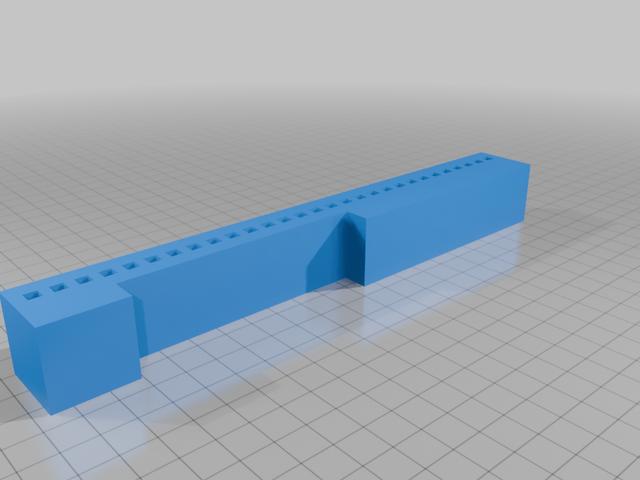
Aimee's Apiary — Langstroth Entrance Reducer + Integrated Mouse Guard (10-Frame, 8-Frame & 5-Frame Nuc)
by AimeesApiary · via Thingiverse
| Format | STL |
| Category | Gadgets |
| License | CC BY-SA |
| Uploaded | Mar 19, 2026 |
⬇ 32 downloads
👁 19 views
Description
A set of entrance reducers sized to commercial Langstroth specifications, designed by a working beekeeper for working beekeepers. This set covers all three standard hive sizes with correct dimensions sourced directly from commercial suppliers. What's included — 18 STL files: Three hive sizes × two opening sizes × two versions (single-piece and two-piece step-joint): 10-Frame — 14.60" total length (Mann Lake WW355 spec) 8-Frame — 12.80" total length (Mann Lake WW340 spec) 5-Frame Nuc — 8.20" total length Each size comes with a large opening (3-3/8") and small opening (1-3/8") version. The entrance notch is positioned 1" from the left end, matching standard commercial placement. Two-piece step-joint version: For folks with smaller print beds - The two-piece halves use a half-lap step joint — both pieces print completely flat with zero supports required. Piece B slides onto Piece A along the long axis. The 0.25mm clearance is tuned for a PETG press-fit. All puzzle halves fit a 220mm print bed (Ender-3 and similar). Integrated mouse guard: Rows of 4×4mm through-holes run the full length above the entrance notch. A mouse skull cannot pass a 4mm gap. Worker bees pass easily. No separate mouse guard needed — it's built in. Unlike stamped metal guards, these won't rust or corrode. Cross-section: 1" × 1" square on all sizes — fits snugly between your bottom board and first brood box. Entrance height: 3/8" — standard bee space, confirmed against commercial specs. Tested slicer settings (Ender-3 V3 KE): Material: PETG (strongly recommended — propolis, heat, and humidity resistant) Layer height: 0.2mm Walls: 3+ perimeters Infill: 40% minimum Supports: None required (all versions) Orientation: Flat on bed, notch face down Usage: Install the large-opening reducer in spring and during nectar flows. Switch to the small-opening reducer during robbing season, when installing a new package, or heading into winter. The integrated mouse guard holes provide ventilation and rodent exclusion year-round even when the reducer is removed.
Originally published on Thingiverse