Balance Weight for Hadley
by Redlow · via Printables
| Format | STL |
| Category | Other |
| License | CC BY-NC-SA |
| Triangles | 7.8k |
| Uploaded | Jan 24, 2026 |
⬇ 34 downloads
❤ 4 likes
👁 166 views
Description
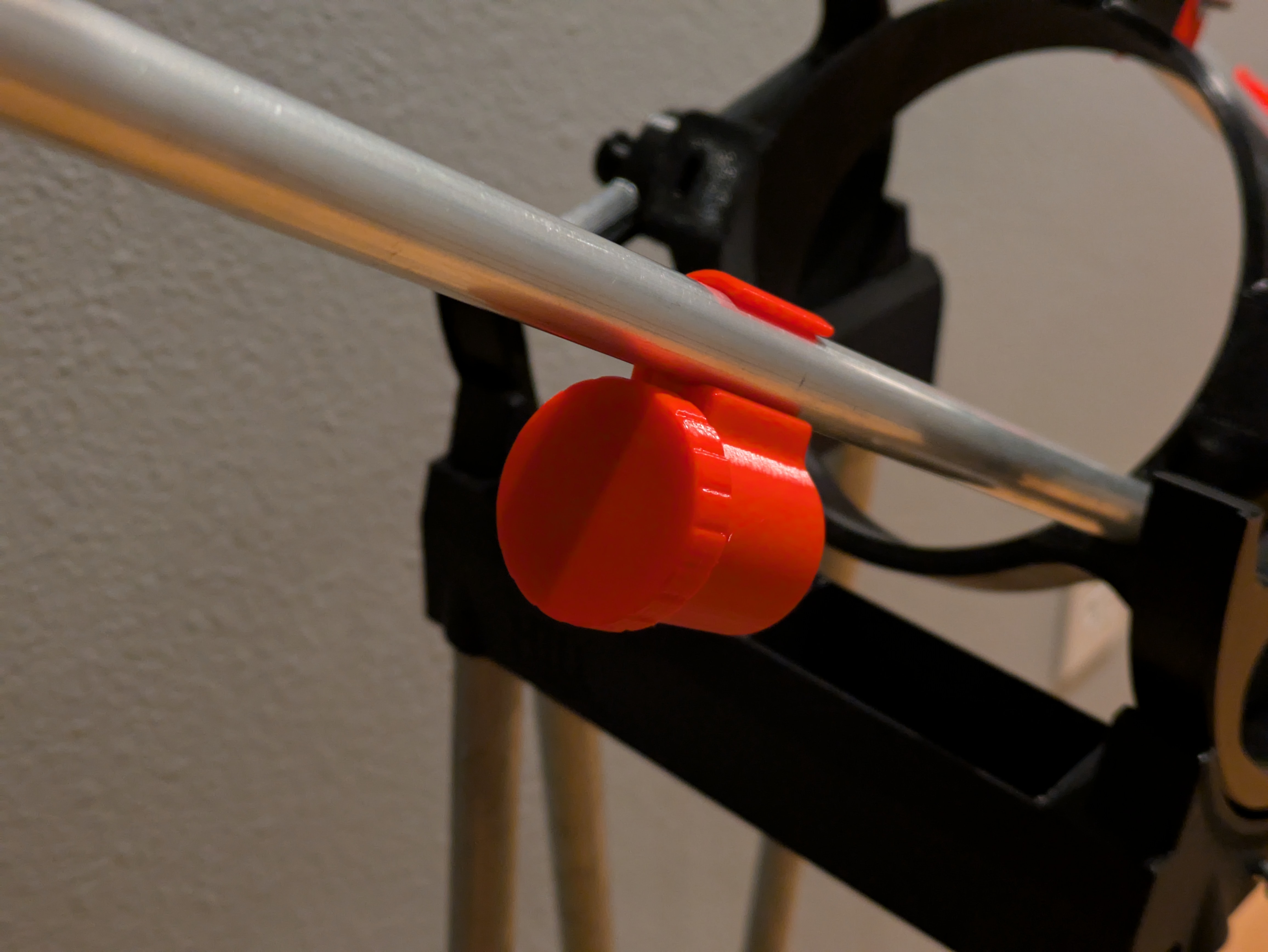
This counterweight for Hadley uses BBs, lead shot or other heavy bulk media as a cheap and readily available mass. For using coins see Counterweights for Hadley, using coins for weight. It makes it easy to balance the telescope when changing accessories like eyepieces, camera or phone, without having to move the middle mount. It also reduces the need for heavy friction, springs or clamping on the altitude bearing. The counterweight clips onto the tube; there are versions for both imperial (½ inch) and metric (12 mm) tubes. Sizes Select the holder depending on what the weight desired. BBs or lead shot have a density of about 6 g/ml Dry sand is about 1.7 g/ml 15 ml Holder 24.5 mm inside diameter With BBs about 100 gram Fits US quarters or 20 euro-cent coins as well 30 ml Holder 30 mm inside diameter With BBs about 200 gram Printing instructions Print the holder in PLA, 0.2 mm layer height, with scarf joints and 3 perimeters. Print the cap in PLA, 0.15 mm layer height , with scarf joints. No supports required. 35 to 45 minutes print time on a Mk4, depending on holder size. Assembly instructions Fill with media/BBs. Screw on the cap The threads might be a bit stiff initially, add a bit of candle wax to lubricate if needed. Use instructions Clip the counterweight onto one of the tubes. Orient it to keep it out of the optical path. Slide it to fine adjust the balance. Creator's note This design was in part inspired by Hadley telescope camera counterweight by Xypris Hadley is a fun thing to design for, check out my other designs in Redlow's Hadley Add-Ons Collection
AI Analysis: This object is a balance weight designed for a telescope, serving as a counterweight to maintain stability. It features a bright red, cylindrical component that attaches to a metal rod, with a circular frame supporting the weight. The design is functional and precise, ensuring accurate alignment for astronomical observations.
Originally published on Printables