Cardboard Reel Friendly Buffer Door (Core One MMU)
by billmi · via Printables
| Format | STL |
| Category | Art |
| License | CC BY-NC-SA |
| Uploaded | Mar 8, 2026 |
⬇ 42 downloads
❤ 13 likes
👁 484 views
Description
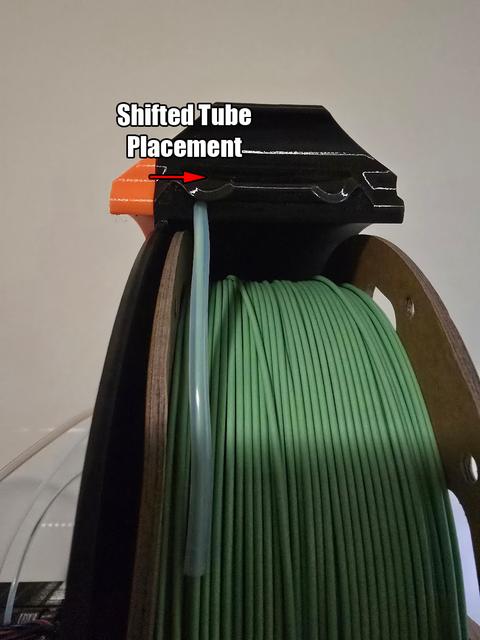
After a few successful small prints with cardboard spools (primarily Overture) on the Core One with MMU3 Community Edition, a problem surfaced with larger prints - the common complaint of filament not feeding, leading to the Core One going through the motions of printing, without advancing filament. In my experience, consistently these print failures began as successful prints, but failed after feeding for various lengths. When a jam occurred, opening the buffer revealed freely moving parts, with no evidence of a jam. A key observation was that every jam occurred as the filament was drawing from the left edge of the reel, on the buffer side. Numerous attempts to resolve feeding from cardboard spools have focused on friction between the edge of the spool side and the buffer base or door, with solutions directed at minimizing friction in those areas. The key to note here, at least in the jams I have experienced, is that friction in those areas is relatively constant, while the failures I have experienced indicate filament feeds fine up until, at some point, the friction increases and causes a failure. After a jam, removing the PTFE tube and filament from the MMU3 allowed for manual pulling in which the filament was bound tight. Opening the door freed it. Through manual pull testing with the door opened and closed I was able to recreate the jam in either condition. Due to the placement of the collet in the buffer door, the PTFE tube is inline with the edge of the filament spool. When the filament draws from the leftmost edge of the reel, if there is enough friction (not so much as to prevent feeding on its own) the PTFE tube pulls straight and applies lateral force on the edge of the spool. This presses the flat side of the spool tightly against the buffer wall with a large contact surface area, much like a brake pad. The tighter it gets, the more resistance it creates, leading to it getting tighter. The intermittent nature of this high friction is consistent with the intermittent feed failures and a strong root cause candidate. The solution seems rather straightforward: realign the collet so that the spool edge won’t ever impinge on the path between the end of the tube and the collet. Shifting the collet with a slight S-curve to the tube’s path through the door added too much friction. The third draft realigns the tube through both the buffer door and buffer door strip. Right out of the gate, there was a jam for a different reason - the face of the PTFE tube caught on a slot in the side of the reel. An anti-jam fitting on the end of the PTFE tube seems to have addressed this and may help with that type of jam with plastic reels as well. The odd angle of the anti-jam tip in the .stl file seems to work well for printing that part, making support material tall enough to easily remove. With these two changes, larger prints from cardboard spools have been going fine on the Community Edition. 6-Month update: With weekly use using a mix of spools including cardboard spools from Elegoo, Overture ond OV V3D, I have had only one jam, and that was unrelated to the spool or MMU3 (filament had loosened up on a 1/4 full reel before loading, and tangled itself in use). Had first converted 1 buffer while testing the 3 design iterations, then a second to do 2 color prints with Overture. Afrer a couple of months of no problems, I swapped out the rest.
Originally published on Printables