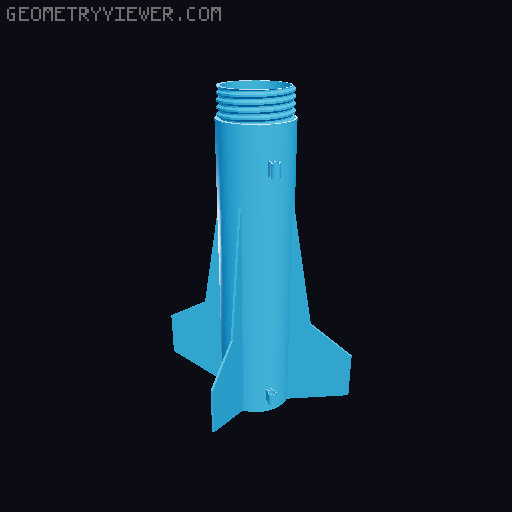
Cernícalo - Full 3D printed amateur rocket
by slopez_tech · via Thingiverse
| Format | STL |
| Category | Home |
| License | CC BY-SA |
| Triangles | 17.9k |
| Uploaded | Apr 18, 2026 |
⬇ 12 downloads
❤ 4 likes
👁 60 views
Description
Cernícalo The Cernícalo is my latest amateur rocketry model. It’s based on the Busardo rocket , which I finished a few months ago (see design and videos), but it’s bigger, faster, and cooler. It has a diameter of 5 cm and a length of 80 cm . The total weight (without motor, payload, and parachute) is approximately 400 g . The fin design is built to withstand high loads and high speeds. Flight Schedule (This section will be updated with information from each flight in the future) Launch and parachute test (E20 motor): May 2, 2026 Onboard camera test (if the first test goes well, F35 motor): May 9, 2026 G80 motor test and non-deployable CanSat: To be determined Motor Simulations The Cernícalo has been simulated using OpenRocket (you can find the simulation file in the downloads). Three different motors were tested: E20-8, F35-8, and G80-13 (the ballast weight changes for each one). E20-8: ~235 m altitude, max speed 63 m/s F35-8: ~500 m altitude, max speed 108 m/s G80-13: ~1000 m altitude, max speed 211 m/s (≈ Mach 0.6) 3D Printing Settings Printed using an Ender 3 V3 with standard PLA. Future version may use foamed PLA to reduce weight. Previous designs included a full combined STL, but due to size and print time, printing parts separately is recommended . Quality Layer height: 0.14 mm First layer height: 0.12 mm Extrusion width: 0.42 mm Seam: Aligned Ironing: Off Strength Perimeter loops: 2 Infill: 20% Pattern: Gyroid Supports Type: Tree Raft/Base: Not required Assembly All parts use threaded connections, except the nose cone, which is press-fit. No screws or glue are required. Payload The nose cone is designed for telemetry systems or a camera. Ballast must be securely fixed inside the lower center of the nose cone. E20: 10–40 g (stable even without ballast) F35: 20–80 g G80: 50–110 g Parachute Recommended radius: 37 cm (≈74 cm diameter) Larger is fine if it fits Use 6–8 attachment points Always use Kevlar line Motor Adapters Three adapters are included for the simulated motors. For other motors, the adapter must be redesigned. The motor must be centered and securely fixed . General Assembly Secure payload/ballast inside the nose cone and close it Use a single Kevlar line connecting: interstage cross parachute nose cone bottom Recommended Kevlar length: 160–240 cm (2–3× rocket length) Talc powder can help deployment. Fold parachute properly (see online guides) Add flame-resistant material above motor Tighten everything securely Launch Motor mount includes: 2 launch lugs (rod launch) Rail guide (aluminum rail launch) Remote launch system: https://slopez.tech/remote-launchpad/ Or use commercial/traditional systems. ⚠️ Safety is critical: Keep people away Secure launch pad Clear flight area Use countdown and warn everyone before launch Extra caution with large motors Notes Data will be updated in the coming weeks Future updates may include: V2 nose cone (camera port) new motor adapters Painted black stripes (not multi-material printing) + logo sticker More projects: https://slopez.tech
Originally published on Thingiverse