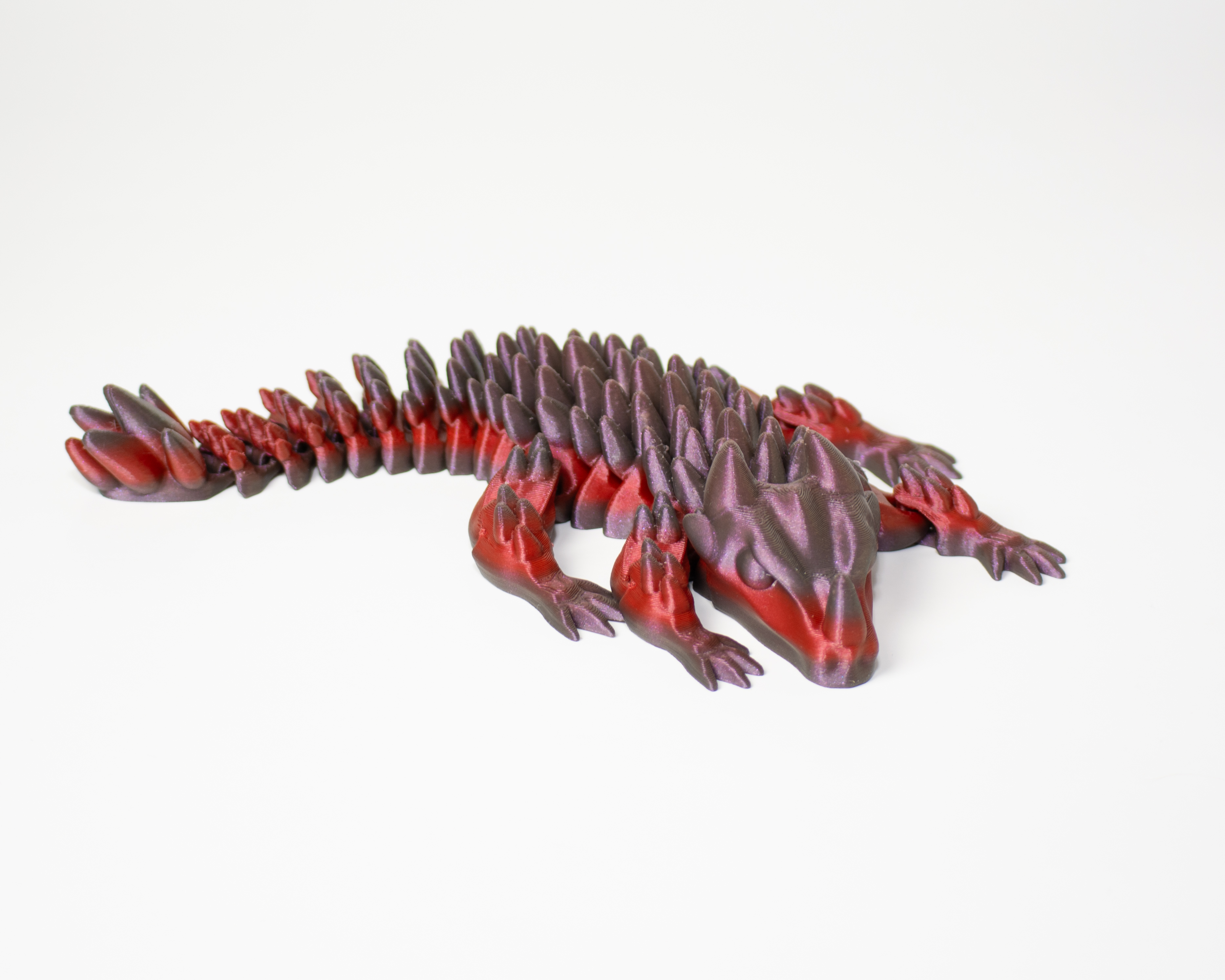
Dragon Egg dice box inserts - Customizable OpenSCAD
by Xavier Faraudo · via Printables
| Format | STL |
| Category | Electronics |
| License | CC BY-SA |
| Triangles | 52.6k |
| Uploaded | Mar 25, 2025 |
⬇ 1.9k downloads
❤ 635 likes
👁 11.9k views
Description
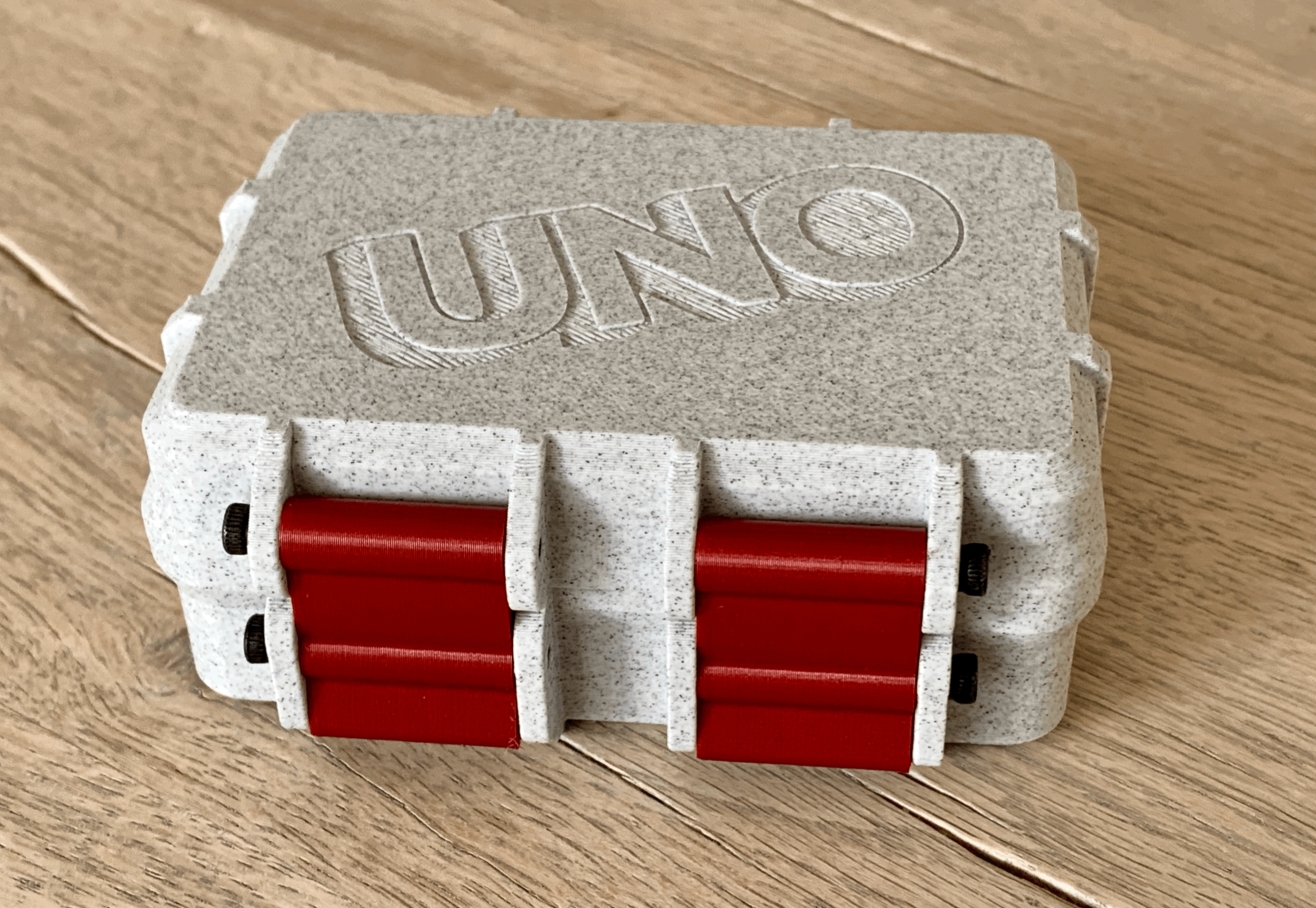
IMPORTANT NOTICE: This model was made for the previous version of Tony Youngblood's Dragon Egg. This is not (yet) compatible with the updated 2025 version; Tony has kindly re-released the older version, clearly labeled as “old”. I'm currently working on hotfix/update for, at the very least, one of the two variants of the newer 2025 version. I will be adding too some QOL improvements to both OpenSCAD source file and pre-generated STLs. This set includes a collection of dice-holding inserts for the beautiful Dragon Egg by Tony Youngblood , and a very powerful OpenSCAD generator so you can make your very own and unique arrangements. Inserts have two parts. The bottom part, the Tray of Readiness , is a dice stand so you can have your math rocks ready for action. The top part, the Prisms of Holding , hold the dice securely in the egg, so they won't wiggle nor scratch one another. You may want to glue some of the inserts, but glue only one, not both ; you need one to be able to turn so you can screw and unscrew the egg. (Likely, the best one to glue is the top part, the Prisms of Holding). Both parts can be created either solid or hollow; a hollow Tray of Readiness, when hollow, can be printed in vase mode, and can also double as secondary storage, to keep that bulky d60 for the attack rolls of the BBEG (who says that Vecna plays by the rules?) or as a time-out dungeon for your misbehaving dice. TIP : If you have a set with those unusual d24 or d30 dice and play D&D (where they're not used), make a set of eggs sized so they can include a d24 or a d30, besides a d20. Spice some with the d24/d30, and the others with the regular d20, and give an egg to your players instead of the Inspiration Die, with just one rule: they cannot open the egg until they use the die. Finding a dice with more than 20 sides (and the possible boost in the advantage roll) will be a nice Easter (Dragon) Egg for your players! There are 14 different dice types to choose from: d4 , either the usual tetrahedron or the not-so-usual truncated tetrahedron. d6 , aka “cube” d8 , either the usual octahedron or the not-so-usual truncated octahedron. d10 , as a trapezohedron. Note that the "good" form of a 5-trapezohedron gives a side view that is pretty square. But there is no such thing as a "regular trapezohedron". Some of them may look more like a rhomboid when viewed from the side, and these may not fit well. (I've seen them sold, but none of my hundred-something d10 is "rhomboid-sided", FWIW.) d12 , either the usual Platonic dodecahedron, or the not-so-usual (and quite weird) Archimedean rhombic dodecahedron. d20 , icosahedron, the "king of RPG dice". d24 , either the nice deltoidal icositetrahedron (kite-shaped faces), or the stranger tetrakis hexahedron (triangle-shaped faces, arranged in squares; a cube all of whose faces have been turned into 4-sided pyramids). d30 , the rhombic icositetrahedron. d60 , either the deltoidal hexecontahedron (kite-shaped faces) or pentakis dodecahedron (triangle-shaped faces, arranged in pentagons; a dodecahedron all of whose faces have been turned into 5-sided pyramids). (Note that, with the exception of the 10-faced trapezohedron, all of these are "regular" polyhedra, either Platonic, Archimedean or Catalan.) There are several arrangements available (single die, 7 dice in a hexagon shape, etc.), and you can choose the type of dice in each of the positions, and the size of every dice type. Note, though, that all dice of the same type will be of the same specified size also. Pregenerated STLS are included for usual dice sizes and types, though. How to use this OpenSCAD customizer There is an extensive PDF added with all the tips and tricks for using OpenSCAD customizer-enabled files. The short version is: download and install the free (as in "freedom to drink free beer") OpenSCAD program, download the .scad file and the .json file (under "other files"), and put the .scad and .json in the same folder. All the parameters in the .scad file are self-explanatory, with a brief description about them. The .json file has the presets (collections of parameters) used to generate the models you see in the pictures (provided as STL in the folders). Once you have a model of your liking, render it with F6 key and then save it as STL with the "STL" button or File->Export->as STL. When you prepare a model, it's better to check the top part (Prisms of Holding) to see if everything fits as it should. Otherwise, you may need to adjust the egg scale and/or the pattern radius adjustment, which makes the dice profiles more "packed" or spaced. Using an existing preset may make your life easier, as you'll only be modifying some tidbits. Measure your dice . This cannot be stressed enough; and don't take just one measure, but measure all pairs of sides or all side lengths, depending on the type of measuring of the die. (Usually it's the indiameter, that's the distance between two opposite sides.) You might be surprised (or not) on how many dice that passed the mumbo-jumbo "floating in saltwater test" are actually "unbalanced" in a noticeable way. Thing is, most of the rounded-edge dice are processed through a tumbler, which isn't a device known for its perfect uniformity; hand-made processes by dice artisans can quite often render more balanced dice than the commercially available ones! Anyway, there's a good variation between dice manufacturers; I used the ones in the greater range from those I own, but I cannot guarantee that your dice will fit. Also, d4 are quite a pain to measure properly (and to step on, also!); they will usually have rounded corners, which makes for a bit of a guesswork if you use calipers or a ruler. It's better if you draw the outline of the d4 using pen and paper, and use a ruler to extend the sides so you have the full triangle profile; measure that. There's an option to add the number of faces at the flat "top" of the Prisms of Holding. These can help you put the dice in the right place, as sometimes shapes can be confusing. You can paint the numbers with a Sharpie, or in some cases use z-based color change. You can disable the text by setting a text height of 0.
Originally published on Printables