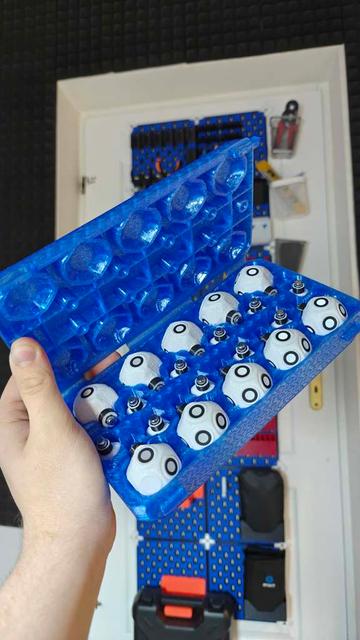
living hinge latching case
by Bigsmoke3D · via Thingiverse
| Format | BLEND |
| Category | Mechanical |
| License | CC BY-SA |
| Uploaded | Apr 16, 2026 |
⬇ 11 downloads
👁 30 views
Description
This is a blank version of the case i designed for storing my magnetic marker balls for 3D scanning. It's a blank slate so you can design your own part holding solutions inside. You can customise this design to accomodate any part/s by bolean'ing the space inside and also just print the hollow version and use it as a latching case for loose hardware and such. The assembly requires a heat source, ideally a heatgun but a hot air soldering gun or a lighter can also work. -You print in in the orientation shown in the picture. Which includes some extreme bridging if you're just printing the hollow version so you need to ideally paint on some supports to prevent sagging. -Pop it of the build plate being careful not to tear the thin living hinge parts, then put the case on a desk, briefly apply heat to the hinge parts, enough to soften them, not melt them, then quickly rotate the top part of the case into closed position and watch the hinge, you want it to have a small radius, not a sharp bend, you can nudge it when it's still hot to correct the shape if needed. do not open the case if the hinge is bent sharply as you'll more than likely snap it, ruining the case. You can repeat the heating if needed. Let it cool down. -after that, do similar thing to the hook parts at the front, heat them up, ideally both at the same time, then gently bend them down and slightly stretch over the latches, let them cool -then test if the case opens and closes & latches properly, you shouldn't need to move the hooks much at all to open or close the case, they should natually spring into closed position, you can just push on the top to close and latch the case and gently tug on them to have the case spring back open. I've been testing the marker ball version of this case for over two weeks and there is no sign of wear on the living hinge parts, suggesting that the thickness of the hinge is tuned properly and the hinge & latch should last many thousands of cycles. Print settings: -I printed all of my prototypes with PETG filament as i suspect that a PLA living hinge would snap very quickly. I didn't test ABS or ASA. The perfect filament here would be PP (Polypropylene) but that's an expensive and non conventional filament so i dont reccomend buying any specifically to print this part. -The case can be slightly resized for preference but any major rescaling will throw off the living hinge dimensions, potentially compromising durability, so be careful. the design is meant to snuggly fit on the 256x256mm bambulab buildplate -i reccomend paying attention to the infill direction on first layers, if the default slicer settings have infill lines going perpendicular to the hinge, then the hinge will most likely fail after a couple of bends. the infill should be aligned in parallel to the hinge or at 45 degrees. (see pictures)
Originally published on Thingiverse