One Piece Compliant Mechanism Blaster (Mark Rober)
by BYU CMR · via Printables
| Format | STL |
| Category | Mechanical |
| License | CC BY-NC |
| Triangles | 217.6k |
| Uploaded | Oct 25, 2024 |
⬇ 28.7k downloads
❤ 4.6k likes
👁 109.4k views
Description
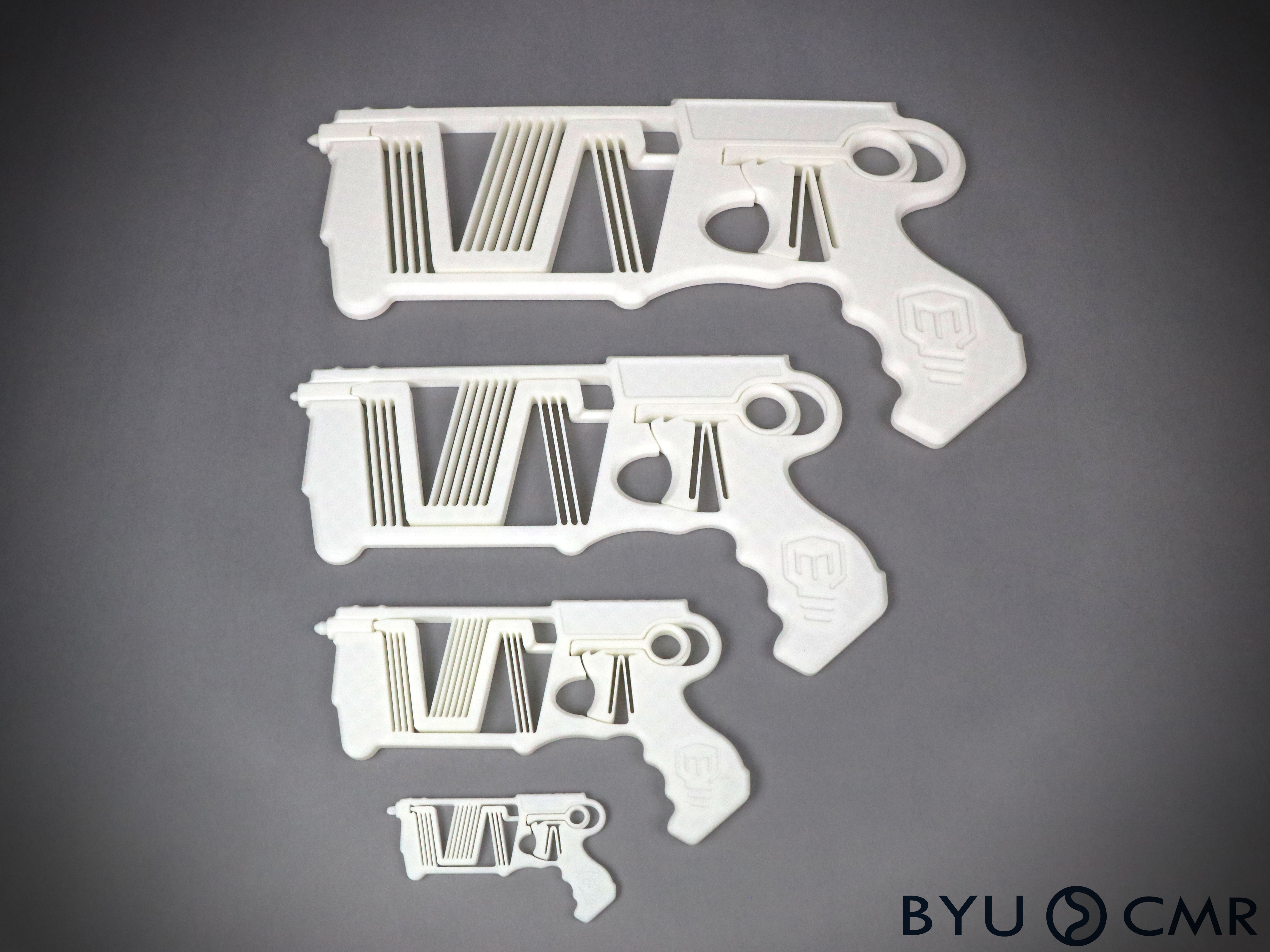
The Compliant Mechanisms Research Lab has worked with Mark Rober and his team to create the world's smallest functional Nerf blaster. Watch his video here ! EDIT 10/16/2023: The ¼-scale files have been updated to a version that latches much better. The smallest functional blaster is manufactured with carbon nanotubes and is small enough for an ant to use, but we have created four 3D printable scaled versions just for you! We also made a version that does not look like a gun for teachers and others. A fun disk launcher was the result, and the files can be found at https://www.printables.com/model/598634-one-piece-compliant-mechanism-disk-launcher. See our related article in Nature Communications. Print Instructions PLA 0.2mm layer height 0.4mm nozzle logo facing up No supports Arming and Launching Full-size Blaster 📷 Image redacted — claim this model to add your own media 📷 Image redacted — claim this model to add your own media 📷 Image redacted — claim this model to add your own media Materials & Fabrication While 3D printing is convenient, the basic materials available are not ideal for compliant mechanisms or storing large amounts of energy in flexible components, like this compliant blaster. We had to turn to other materials for more optimal performance. Amorphous Metal Amorphous metal, also known as bulk metallic glass, is a zirconium alloy with fantastic mechanical properties. Compliant mechanisms perform best with a high strength to modulus of elasticity ratio. This material reaches incredible strength without any plastic deformation with the elasticity of spring steel. 📷 Image redacted — claim this model to add your own media Nylon High-strength nylon is an excellent polymer choice for compliant mechanisms. This prototype was made using selective laser sintering. 📷 Image redacted — claim this model to add your own media The nylon SLS printed model can be painted to give us the familiar look of the Nerf Maverick 📷 Image redacted — claim this model to add your own media Wood Surprisingly, compliant mechanisms are not just limited to metals and polymers. While it may not have as optimal mechanical properties, some woods, such as baltic birch, can also be milled or laser cut with satisfactory performance. 📷 Image redacted — claim this model to add your own media Fabrication of the Smallest Nerf Blaster 📷 Image redacted — claim this model to add your own media The smallest nerf blaster was manufactured by growing carbon nanotubes in a furnace. This was critical to allow us to scale down to microscopic sizes. Carbon nanotubes are grown by layering alumina onto a silicon wafer and then, using photolithography, we create a photoresist design on top. The photoresist design is the negative space of the final design. Iron is then also layered across the wafer. After being sonicated in NMP the photoresist and iron layer in the negative spaces of the design are dissolved. The alumina in between the iron and silicon allows the iron and silicon to remain separate when heated to extreme temperatures. In a furnace, we heat the sample in hydrogen. This causes it to form tiny iron spheres. For a short time we saturate the sample with ethylene (C2H4). The carbon atoms in the ethylene attach to the iron creating a tube shape, and the hydrogen is filtered out of the furnace. These little tubes are extremely small and when side by side they create a "carbon nanotube forest". 📷 Image redacted — claim this model to add your own media Then, at a higher temperature we continue to saturate the sample in ethylene and that allows carbon to grow in between the tubes. This process is called infiltration and it makes the design much stronger. 📷 Image redacted — claim this model to add your own media Carbon nanotubes have been used to manufacture compliant mechanisms in the past, and they continue to be an exciting prospect to explore for the future. They allow us to create extremely small and working mechanisms that otherwise we could not make. This could benefit technology, biology, and engineering studies in many ways. Learn More This design was developed by the Compliant Mechanisms Research Group (CMR) from Brigham Young University (BYU). Follow us at @byucmr on Instagram, @CompliantMechanismsResearchGroup on Facebook, or visit the BYU Compliant Mechanisms Research (CMR) website to learn more about compliant mechanisms. Technical Information For in-depth technical information, see the following publications: D. N. Hutchison et al ., " Carbon Nanotubes as a Framework for High-Aspect-Ratio MEMS Fabrication ," in Journal of Microelectromechanical Systems , vol. 19, no. 1, pp. 75-82, Feb. 2010, doi: 10.1109/JMEMS.2009.2035639. B. H. Hanna et al ., " Mechanical Property Measurement of Carbon Infiltrated Carbon Nanotube Structures for Compliant Micromechanisms ," in Journal of Microelectromechanical Systems , vol. 23, no. 6, pp. 1330-1339, Dec. 2014, doi: 10.1109/JMEMS.2014.2312847. Jones, K., Jensen, B. D., and Bowden, A. (October 17, 2013). " Fabrication and Testing of Planar Stent Mesh Designs Using Carbon-Infiltrated Carbon Nanotubes ." ASME. J. Nanotechnol. Eng. Med . May 2013; 4(2): 020903. To learn more about compliant mechanisms in general, see the BYU Compliant Mechanisms Research (CMR) website or these books: Compliant Mechanisms , Handbook of Compliant Mechanisms Intellectual Property The downloadable 3D print files provided here may be used, modified, and enjoyed for noncommercial use. To license this technology for commercial applications, contact: BYU Technology Transfer Office 3760 Harold B. Lee Library Brigham Young University Provo, UT 84602 Phone: (801) 422-6266 https://techtransfer.byu.edu/contact
AI Analysis: This image shows three progressively smaller blasters, each with a distinct design featuring a unique internal structure. The blasters are constructed from a white material and appear to be part of a mechanical system designed for play. The design includes a compliant mechanism that allows for smooth movement and firing, making them suitable for use in a game or toy. Notable features include the detailed internal components and the overall structure that supports the functionality of the blaster.
Originally published on Printables