Satellite CHIME
by Wolfi01 · via Thingiverse
| Format | STL |
| Category | Other |
| License | CC BY-NC-SA |
| Triangles | 906 |
| Uploaded | Mar 1, 2026 |
⬇ 207 downloads
👁 24 views
Description
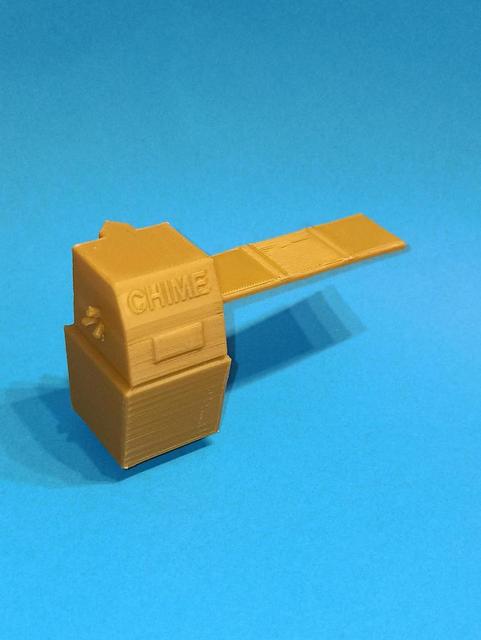
The Copernicus Hyperspectral Imaging Mission for the Environment (CHIME) is one of six missions in the Copernicus Expansion Missions. CHIME will consist of two satellites – CHIME-A and CHIME-B – scheduled for launch in 2028 and 2030, respectively. Both will provide hyperspectral images to map changes in land cover and develop sustainable agricultural technologies. Unfortunately, there are currently no good photos or descriptions of what the CHIME satellite will actually look like. Therefore, I created a model using the available information, which is relatively easy to print. Due to the large antenna, a slightly higher infill (to prevent it from tipping over) and a fair amount of support material are required. In my tests, the tree support didn't work particularly well, so I used the standard support. Using the parameter Threshold Angle=15 (in the Orca slicer, or Overhang Angle in Cura) should provide optimal support. Copernicus Hyperspectral Imaging Mission for the Environment (CHIME) ist eine von sechs Missionen der Copernicus Expansion Missionen. CHIME wird aus zwei Satelliten bestehen – CHIME-A und CHIME-B, die 2028 bzw. 2030 starten sollen. Beide werden Hyperspektralbilder liefern, um die Veränderungen der Bodenbedeckung zu kartieren und nachhaltige Verfahrenstechniken für die Landwirtschaft zu entwickeln. Vom Satellit CHIME gibt es bisher leider kein gutes Photo bzw. Beschreibung, wie er tatsächlich aussehen soll. Ich habe deshalb mal mit der vorhandenen Information ein Modell erstellt, das relativ einfach zu drucken ist. Wegen der großen Antenne wird allerdings ein etwas höherer Infill (damit er nicht umfällt) und einiges an Support-Material benötigt. Bei meinen Tests hat der Tree-Support leider nicht besonders gut funktioniert, deshalb habe ich den normalen Support verwendet. Mit dem Parameter Threshold Angle=15(beim Orca-Slicer, bzw. Overhang Angle bei CURA) sollte der Support optimal sein.
Originally published on Thingiverse