Shower Curtain Hook
by Line Arc Line · via Printables
| Format | STL |
| Category | Mechanical |
| License | CC BY-NC-SA |
| Triangles | 3.6k |
| Uploaded | Nov 2, 2022 |
⬇ 2.3k downloads
❤ 467 likes
👁 5.6k views
Description
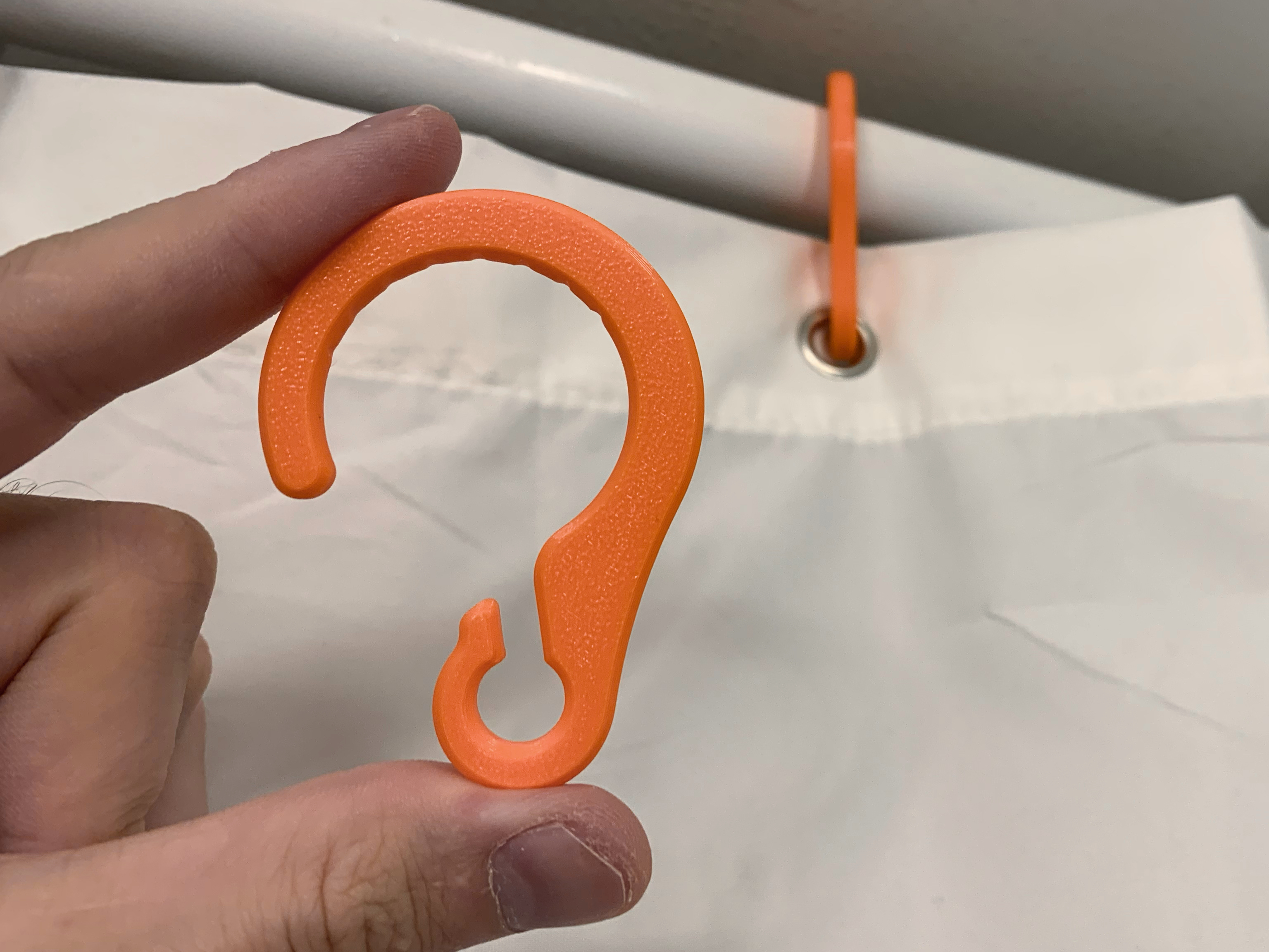
When searching for a shower-curtain hook, I struggled to find one that was not flimsy or had odd design choices. So I made my own that meets my criteria! Goals I wanted my hook to: Be able to support heavy shower curtains and resist sagging over time Hold the curtains close to the rod so not as much airflow escapes over the curtain Be easy to assemble and set up Slide smoothly on the curtain rod Hold both the shower curtain and curtain liner. Not have parts or materials that rust over time. Be fully printed, with no need for other materials. Have the beautiful look of an intentionally designed object Through a few iterations on this hook, I think I have met these goals! Features The hook diameter for the curtain rod is parametric, and is intended to be 120% of the diameter of the curtain rod. This is the ratio that I have found slides best on the curtain rod. (My curtain rod is 26mm in diameter) You can modify the hook to be the best size for your curtain rod using the first couple sketches in the Fusion 360 file. 📷 Image redacted — claim this model to add your own media The opening in the rod hook is 75% of the curtain rod diameter so the rod snaps nicely into place using the flexibility of the plastic. 📷 Image redacted — claim this model to add your own media The curtains (curtain and liner) are supported directly underneath the center of the curtain rod, and the distance between the rod and curtain can be adjusted using the “Distance to Top of Curtain Hole” sketch. 📷 Image redacted — claim this model to add your own media If you look closely, the thickness of the rod hook is slightly asymmetrical. This is to retain rigidity under the force of heavier curtains. 📷 Image redacted — claim this model to add your own media The sliding surface of the hook consists of a radius. I tried a simple chamfer, but I found the 45deg edges wore down quickly when sliding the hook quickly on the curtain rod. I implemented a radius on the sliding surface to ensure a consistent surface touching the curtain rod when the rod is being pulled at an angle. 📷 Image redacted — claim this model to add your own media I put indentations in the sliding surface to reduce the surface area that is touching the curtain rod. You can suppress these in the Fusion file if you don’t need them. Source Files I want you to be able to change the design if you need or want to, so I’ve included the Fusion 360 file in the downloads. If you change it, consider posting it as a remix! Print Instructions I think this is a pretty straightforward print for an FDM printer. No supports are needed, and you can use a brim if you’re worried about warping. I printed mine with two wall perimeters and 15% infill. I am using PLA, and it has held up nicely over the two months I have been using the most recent design. I think once I’m fully satisfied with the form and function, I’ll re-print them in PETG for longevity. Thoughts One of the most wonderful things about small-scale manufacturing is that it allows people to make beautiful objects that are not limited to the traditional engineering design space. I am not limited as much by the material used or the time it takes for me to design. Even on objects that may be taken for granted, the community can discover the best possible form and bring beauty to them through meticulous attention. I really enjoy doing well organized CAD, and this was a very fun weekend project. I’d love to see you post your makes and remix my ideas. If this has gotten you considering shower-curtain hangers more carefully like it did for me, consider liking the design, leaving me a tip using the 📷 Image redacted — claim this model to add your own media button at the top-right and subscribing to my designs here . 📷 Image redacted — claim this model to add your own media
Originally published on Printables