Squishy Fidget D20
by alexberkowitz · via Printables
| Format | STL |
| Category | Other |
| License | CC BY-SA |
| Triangles | 177.5k |
| Uploaded | Feb 4, 2026 |
⬇ 6.5k downloads
❤ 1.5k likes
👁 43.0k views
Description
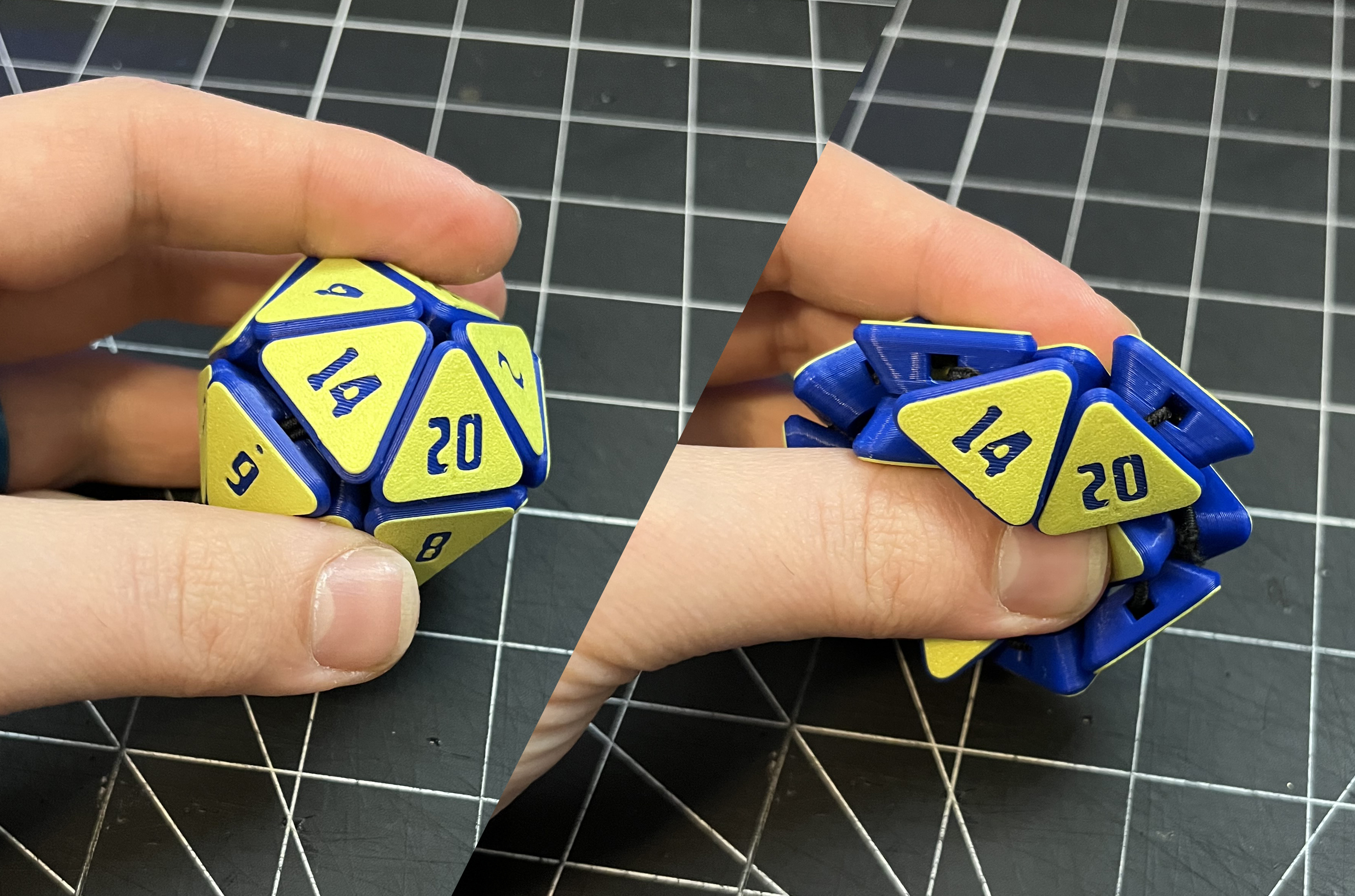
This fidget d20 is squishy and satisfying, perfect for your desk or backpack! Note: This die has a tendency to not remain perfectly round, and as such isn't very good for actual TTRPG play. Better stick to your solid dice for that! Materials Needed In addition to the printed parts, you will need: 1.5mm diameter elastic cord–The exact diameter is not crucial, but you don't want to go larger than this. You also want to make sure the cord has enough stretch to both work with and to make the final toy squishy. Something to cut the elastic with Instructions Print both files. No supports are required, and material doesn't matter (I just used regular PLA). You may wish to add a pause after the second layer on the face pieces so you can swap colors to improve contrast, but this is not a necessary step. Lay the face pieces down in the correct positions. You can reference the stringing guide to determine which face should go where. Flip the face pieces over so their open ends are facing upwards. It may help to place some packing tape sticky-side-up on your work surface and place the pieces onto it in the correct pattern to prevent them from moving during the next steps. Cut two lengths of elastic, about 8in/200mm long. You may wish to melt the ends with a lighter to make stringing easier. Cut one of the pieces in half. Take note of the stringing guide –it has three distinct loops of elastic: two simple loops at the top and bottom, and a zig-zag loop through the middle. Starting on one side, string together the face pieces. Make sure to string the beads on where the guide asks you to. Try to keep the elastic from twisting or tangling as you string the face pieces on, as that will make tightening it later easier. Don't tie the loops yet. Starting with the top and bottom loops, pull the elastic tight and tie together. A simple overhand knot–with some additional knots to secure it afterwards–makes this easy. Pull the knots tighter than you'd think; your goal is for the elastic to be tight enough that the faces are held together, not hanging loosely. Make sure your knots are in the recesses in the back of the pieces, NOT between two pieces. Otherwise your die will be lumpy! To tighten and tie off the central loop, the process is similar. But due to the increased friction, you won't be able to simply pull the ends to tighten it fully. Instead, start at the center and, following the order of the pieces (the stringing guide is helpful for this) pull the cord in between each piece until it is tight. You can make a single overhand knot where the final knot will be to help hold the tension. Once everything is tied and tight, trim any excess elastic and tuck the ends in. Enjoy!
AI Analysis: This object is a squishy fidget spinner designed as a D20 die, commonly used in tabletop role-playing games. It features a flexible, rubbery texture that allows it to be spun and rolled, providing a tactile and engaging experience for players. The die is marked with numbers from 1 to 20, making it suitable for various games that require rolling a die. Notable features include its vibrant yellow and blue color scheme and the clear, bold number markings on each face.
Originally published on Printables