Yet Another Filament Drybox (YAFDB)
by Kramer · via Printables
| Format | STL |
| Category | Electronics |
| License | CC BY-NC |
| Triangles | 150.5k |
| Uploaded | Dec 10, 2025 |
⬇ 28 downloads
❤ 12 likes
👁 480 views
Description
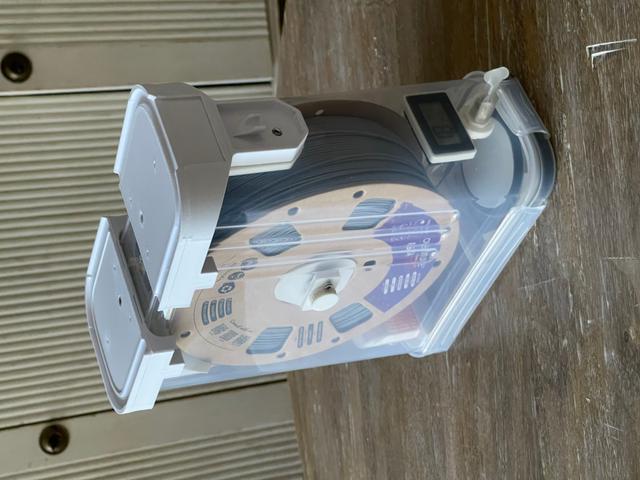
I was very impressed with the Ultimate Cereal Container Filament Drybox by @GunplaMark . I owe him a great debt of gratitude for all the work he put in designing, testing, and publishing the original project which I have remixed. There were a few things about it that I wanted to improve. The main thing was I wanted some way to rewind filament onto the spool after unloading from the printer without opening the drybox. I also found some of the parts difficult to print and wanted to see if I could tweak them to avoid supports, warping and other issues. The project got a little out of hand and I ended up modifying almost all of the original parts. The main feature I added was to suspend the filament spool by its central hole with a spool holder and adding magnets to the holder so that a rewinding tool with matching magnets could spin the spool. I originally used ball bearings on the spool holder axle and removed the drag flaps on the edge of the spool but found that I had made the system have way too little friction and removed the ball bearings and put back in a modified drag flap. I found the back and front corner pieces to be very hard to print since they had features on both the “top” and “bottom”. I ended up splitting the parts such that both the “top” and “bottom” could print as the last layers and used a hinge to connect them so that they can be folded and glued for easy assembly. The original corner pieces allowed for mounting the drybox by a slot on the back corner. I wanted to be able to mount the drybox to the side of a printer, so added 4 holes on the corner pieces on the side to mate with side mounting posts. My original spool holder design uses a tapered disk to clamp into the spool from each side. Unfortunately this does mean that since the spool hole size varies widely (please, please standardize this!) you need a lot of different size spool holders to accommodate all the different spools you may have. I subsequently designed what I call “Springy Spool Holders” that use plastic springs on one side of the spool to fit the hole and a flat clamping piece on the other side of the hole. This has the advantage of fitting a wider range of hole sizes with a single part. It does have a down side however--the springs are fragile and I am not sure how long they will last. I broke off a spring piece if I dropped the part on the floor. I consider the "springy" version a beta at this time -- I have been having problems with them loosening while printing and causing jams so I would stick with the rigid holders. I am including both designs here. Bill of Materials You need some hardware to make a drybox. This is a list of all the hardware you will need for one drybox. It does not include things such as tools and the rewinder. In include links to Amazon (USA site) that I used to order things at the time I published this. 4x M3x8 SHCS 4x M3x6 SHCS 8x M3 Nuts 300mm stainless steel tube, 8mm OD 0.5mm wall thickness, cut to length ( Amazon link ) 1x PC4-M10 Pneumatic Connector Fiting/Bowden Tube Coupler, 4mm, 6mm threads ( Amazon Link ) 3x N52 Mini Neodymium,18mm x 3mm Round Super Strong Premium Neodymium Fridge Magnet ( Amazon Link ) 1x Mini Hygrometer Indoor Humidity Meter 1.12" x 0.57" ( Amazon Link ) 1x Cereal Drybox (the type with three vertical indentations at the front) ( Amazon Link ) You will need some tools and glue to assemble the drybox and magnets for the rewinder. If you have the tools already, you are good to go, but I include Amazon links for things that I used that worked. 6x N52 Mini Neodymium,18mm x 3mm Round Super Strong Premium Neodymium Fridge Magnet ( Amazon Link ) – for the rewinder Small tubing cutter to but the 8mm stainless steel tube ( Amazon Link ) Step drill set that includes a drill for the range 4mm-22mm (in 2mm steps) and a drill for the range 4mm-12mm (in 1mm steps) ( Amazon Link ) 3.4mm drill Cordless drill Deburring tool M3 Hex head driver Thick superglue ( Amazon Link ) Thick superglue for plastic ( Amazon Link ) Printed Parts First note that the folder “Original Parts” are copies of what GunplaMark created--I have not modified those parts. The system as designed by GunplaMark includes the ability to use an adaptor to put it onto a polymaker polydryer filament dryer. Assuming you want to use the drybox with a dryer, the parts inside the container should be heat resistant. These are the filament types I used with the specific brand in parenthesis--obviously, choose the brand you like best: ASA (ERYONE High Speed Filament) – all the internal parts except for the desiccant bin Clear ABS (SUNLU) – for the desiccant bin and lid TPU (Polymaker High Flow TPU Filament Clear) – for the filament exit cap PLA (eSUN PLA+ Filament) - the top corner pieces and the printed tools I have organized the printed parts in folders. I have tried to orient the parts so they will go into your slicer in the printable orientation. You will need to print out these parts in the tools folder for use during assembly: drilling jig, axle length gauge, outer wrench, inner wrench. I used PLA for these parts. And you will need the hole-jig part in the Original Parts folder (also used PLA). You will need to print out the parts for the rewinder to rewind filament back into the box using the magnets. You need only one of these for all your dryboxes. There are two parts to it, again in the tools folder: Rewinder and Handle. I printed these in PLA. And if you want to use the polymaker polydryer you will need to print out the polydryer-adapter part from the Original Parts folder in a heat resistant material. For each drybox you will need to print all the parts in folders PLA and High Temp with the appropriate filament type. You will need the desiccant-bin and hygrometer-holder from the Original Parts folder. You will need one of the TPU coupler caps--there are 2 versions, one is “extended” so that there is a cavity in which a flexible filament like TPU can sort of coil since it is hard to insert it into the capture hole. As mentioned before there are two different designs for the spool holder pieces: “springy” and “rigid”. There are two folders with the two variants. Because the rigid version only handles at most 3mm of variance in spool hole size I published a range of sizes in 1mm increments so that you should be able to find one to fit any spool you own. The springy version fits a wider range of hole sizes so it has parts in 5mm increments. Note that the springy version has one side that has the “springs” and the other holds the magnets and has no springs. There are just two sizes of the part with the magnet, a large and small as they can cover a large range spool hole sizes. I consider the springy version a work-in-progress as I have been having problems with them unscrewing while printing and jamming -- stick with the rigid for now. The only part that will need supports is the “Base Back” part that has to straddle the hexagonal feature in the drybox lid. I used old-school supports for it and it prints very cleanly and removes easily (at least with my Qidi Q2). You will need brim on the Axle Tip and hygrometer-holder parts. I printed the parts with a 2mm layer height. There are some threaded parts that need good vertical resolution. You could probably get away with 3mm layer height for many of the parts. I used a 0.4mm nozzle for the ASA parts and a 0.6mm nozzle for the PLA parts. Assembly I have created a video that I published on Youtube that goes through all the steps to assemble a drybox. I went into a lot of detail so hopefully it will be clear what to do. After doing a few of them it goes pretty quickly. You will have to decide which type of spool holder you want to use: the “springy” one or the standard rigid one. The build video is using the standard, rigid one, but the springy version is very similar to build. Spool Hole Diameter and Spool Holder Size For the rigid spool holders, you will want to choose the size to print based on the measured hole diameter of the spool. As an example for an Overture PLA spool, the spool hole diameter is approximately 55.6mm. The best fitting spool holder is labeled “53mm”. The 52mm holder fits also. The 54mm fits but is getting near the too large size. So generally you want to pick a spool holder that is labeled 2mm-3mm smaller than the hole diameter. Note that the spool holder labeled number is the diameter of the inner-most (smallest) part of the taper. The taper flares out from this by about 4mm so the largest diameter for the 53mm holder would be 57mm. Spring Loaded Spool Holders (WIP) For the spring loaded spool holders they should fit spools with hole diameters within the labeled range for the spool holder. The non-spring loaded side of the holder has a large and medium size. The large size has an outer diameter of 92mm so should fit spools with a hole diameter up to 85mm comfortably. The medium size has an outer diameter of 76mm so should fit spools with a hole diameter up to 70mm. But for most spools the large would fit an smaller spools, it just takes more plastic to print. I have been having trouble with these holders. I have had one unscrew while printing causing a jam. The problem is that you cannot screw them tight and both sides do not get forced into the spool hole. I recommend using the rigid holders for now. Rewinder Tool To assemble the rewinder tool, you need to glue three stacks of two magnets each into the magnet holes. I just use CA glue for this. I would glue the magnets to each other as well. Then attach the handle by glueing it into the whole in the circular base. Make sure you do the magnets before the handle so the base will lie flat. To use the rewinder, simply place it onto the outside of the drybox aligned with the spool holder with the magnets. Then spin the rewinder to spin the spool. The N52 magnets I bought are so strong, that I think I could have used just 3 magnets (no stacking) for the rewinder, but more is better, right? Mounting Posts The original design includes a mounting slot at the rear of the drybox. This works well for mounting on a wall or surface behind the printer. But I needed to be able to mount the box on the side of a printer. The four holes on the sides of the top pieces are used for this. I have created 2 different mounting posts as an example of how to do this. The first is a mount that you can screw into the side of a printer. I print the entire thing out of TPU because I wanted great layer adhesion and a good sliding fit into the mounting holes. You print two of them for the front and back holes. I used this with my Qidi Q2 printer; I used M3 screws to mount it into the riser I had printed at the top of the printer. The second mount is what I call the “elevator”. It is designed to stick up above the printer and allow the filament exit to be level with the top of the printer. Each mount consists of two pieces, a beam that is fastened to the printer and a TPU piece that has the mounting posts that mate with the drybox. The TPU pieces slide into slots in the beam – they should stay in there with friction, no glue required.The beams are designed to screw to a 3030 extrusion as I used it for my Ratrig V-core 3.1. For using the back mount, go to the original first version of GunplaMark's drybox which includes many different types of “Mounting Slides” which should fit. Wall Mounting Strips I created 3 parts that can be used to make an arbitrarily long mounting strip that can be attached to a wall to allow the dryboxes to be slid onto the back mount. There are 3 parts, a left end, a right end, and the middle piece. You will need one each of the left and right ends and then print as many middle pieces you need to create the desired length. I have made it so they have "puzzle pieces" joins between the parts. Originally I was going to glue them, but after putting them on the wall with screws I realized it was unnecessary. I used #8 deck screws and plastic plaster wall anchors to mount them to the wall. A laser level helps a lot to get it each piece level as you mount them one at a time. I printed mine out of PETG which I think is a good material for this application. They are fairly long pieces so you will need at least a 300mm bed printer. The design files for these strips are available on Onshape at this link: Drybox Mounting if you wish to make modifications to them. Onshape Design Files I used onshape to create all of my parts and make modifications to the existing parts. I recognize that for many you will need some tweaks to make things work better for your situation. Currently you can get a free hobby-level subscription to onshape so all should be able to take advantage of this if they can figure out onshape. This is the link to the project which you can use to clone it into your workspace. Note that the spool holder variants use custom feature script to create all the different sizes of holders. Update 12/04/2025: Added info about having problems with the spring loaded spool holders and recommending not using them for now. Update 12/10/2025: Added new wall mounting strips parts and description. Add reference to original drybox that mount geometry came from to the remix list.
Originally published on Printables